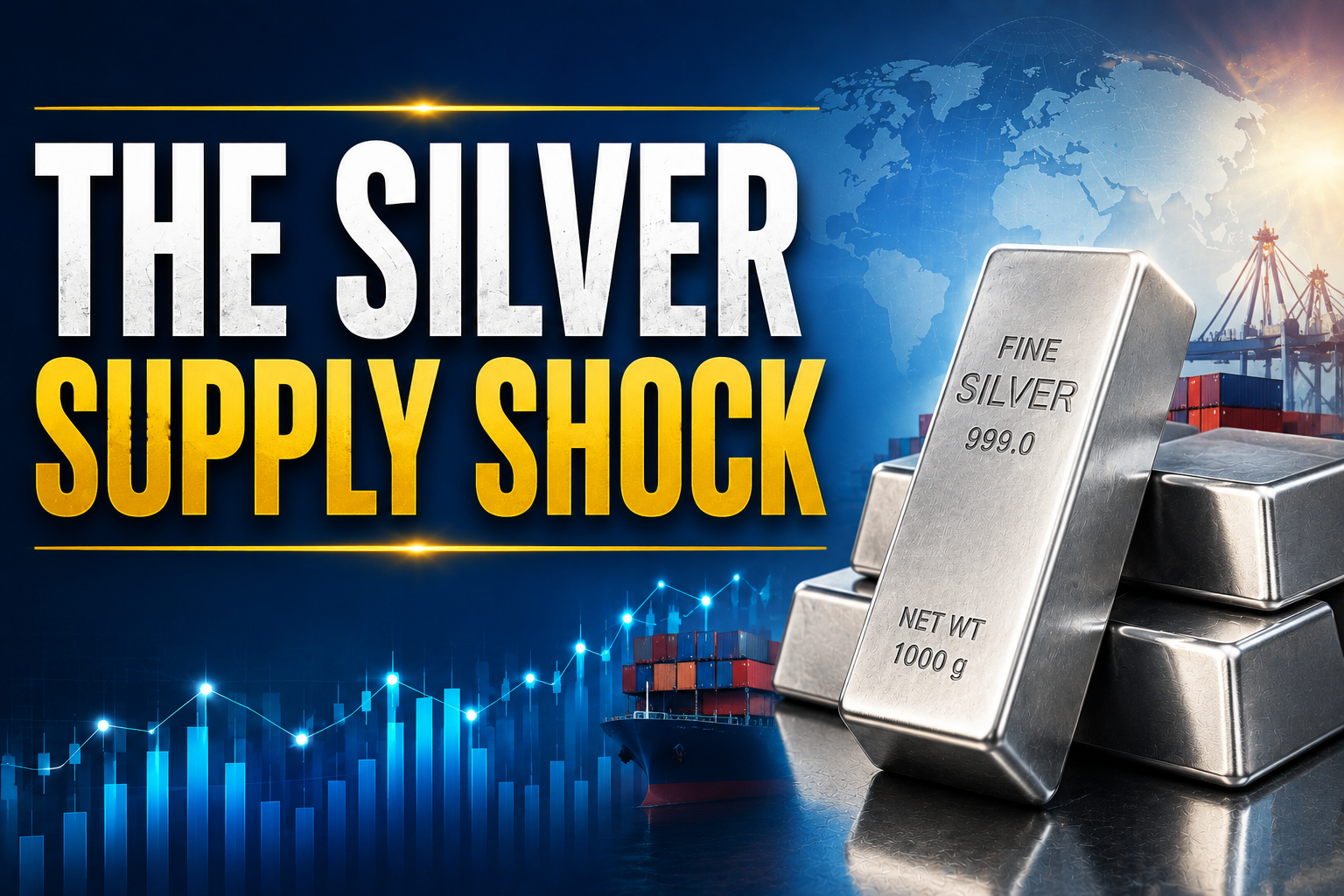
India's silver market is facing tighter physical supply as import restrictions disrupt shipments and push domestic premiums higher. Here's what is driving the latest silver market developments
Description
Silver Traders Brave Red Tape to Capture Indian Premiums
India's silver market is facing tighter physical supply as new import restrictions disrupt shipments and push domestic premiums higher. Here's what is happening and why it matters.
Silver has attracted significant attention in 2026, not only because of its price performance but also because of changes in the global physical supply chain. India has tightened imports of specified silver bars, while China has introduced tighter export-licensing requirements. Together, these developments have increased focus on the availability and movement of physical silver.
India Tightens Silver Imports
In May 2026, India's Directorate General of Foreign Trade (DGFT) changed the import policy for specified silver bars from “Free” to “Restricted.” Imports covered under the specified categories now require the applicable government authorisation.
The change came amid increased scrutiny of silver-related trade flows and concerns around the use of free-trade arrangements.
Earlier, India had also taken action concerning certain silver jewellery imports from Thailand. Reports indicated that imports increased from approximately 4 tonnes to 40 tonnes, representing a 10X increase, while Thailand's share of these imports rose from around 78% to 98%.
These developments led to greater scrutiny of silver imports and the possibility of trade-rule circumvention.
The Licensing Bottleneck
The new import framework has created an additional administrative hurdle for market participants.
Import licences require government approval, while the committee responsible for reviewing applications reportedly meets only once or twice a month. Reports indicated that most banks were still awaiting approvals, with only a limited number having obtained the required licences.
For a commodity market, delays can affect physical availability. When shipments that would normally enter the country are delayed, local buyers may have fewer sources from which to purchase physical metal.
India's Silver Imports Plunged
The impact can be seen in reported import estimates.
India's silver imports were estimated at approximately:
747 tonnes in January 2026
compared with:
29 tonnes in June 2026.
That represents a decline of approximately 96%.
The fall in imports does not necessarily mean that Indian demand disappeared. Instead, it highlights the impact that restrictions and licensing delays can have on the availability of physical silver.
What Are Silver Premiums?
A silver premium is the difference between the international benchmark price and the price buyers pay for physical silver in a particular local market.
When physical supply becomes tight, buyers may be willing to pay more than the international benchmark to secure available metal.
This can create a situation where:
Lower imports → tighter physical availability → higher local prices → higher premiums
In July 2026, reports indicated that Indian silver premiums had moved to multi-month highs, reflecting tighter conditions in the physical market.
This is the key reason traders are paying attention to the regulatory bottleneck: where physical availability is limited, the local premium can become an important market signal.
China Adds Another Layer
India is not the only major market experiencing changes in silver trade.
From January 2026, China implemented tighter export-licensing requirements for silver. China plays a significant role in the global silver supply chain because of its refining and processing capacity.
Reports have estimated that around 60%–70% of refined silver traded globally could be affected by China's export-licensing requirements.
China's role means changes in its export policy can have implications beyond its domestic market.
It is important, however, to distinguish between tighter export licensing and an outright export ban. The change represents greater regulatory control over exports rather than a complete prohibition on silver shipments.
Silver Has an Industrial Demand Story
Silver is different from many other precious metals because it has extensive industrial applications.
It is used in:
- Solar photovoltaic technology
- Electronics
- Electrical applications
- Automotive and EV systems
- Telecommunications
- Other advanced technologies
This gives silver a dual demand profile.
Investment demand is influenced by investor interest and precious-metal flows, while industrial demand is linked to manufacturing and technological applications.
As a result, silver prices can respond to a wider range of factors than investment demand alone.
Why Physical Supply Matters
The recent developments in India highlight an important feature of commodity markets: international prices and local physical-market conditions do not always move in exactly the same way.
A global benchmark reflects international trading conditions. A local market, however, can experience its own supply constraints.
If imports slow sharply while demand remains relatively steady, physical silver can become harder to source. That can result in higher local premiums even when the international silver market is responding to different factors.
This makes physical-market indicators important when analysing silver.
What About Silver Prices?
Silver had already experienced a significant price movement before the latest import restrictions became a major focus.
Indian silver prices crossed the ₹2 lakh per kg level in early 2026.
However, silver prices are influenced by multiple factors, including:
- Interest rates
- US dollar movements
- Industrial demand
- Investment demand
- Mine production
- Recycling
- Geopolitical developments
- Physical-market availability
- Futures-market positioning
Therefore, India's import restrictions should not be viewed as the sole reason behind silver's price movement.
What Does This Mean for Investors?
The recent developments demonstrate why commodity markets need to be analysed beyond headline price movements.
For investors evaluating exposure to precious metals, relevant considerations can include:
Asset allocation: How would silver exposure fit within the overall portfolio?
Risk profile: Can the portfolio accommodate commodity-related volatility?
Investment horizon: Is the exposure consistent with financial objectives and time horizon?
Diversification: Does the exposure provide an appropriate diversification benefit within the overall portfolio?
A sharp rise in an asset's price does not, by itself, establish whether that asset is appropriate for a particular investor.
The Bigger Picture
India's silver market is currently being shaped by several developments occurring at the same time:
India: Specified silver-bar imports moved from “Free” to “Restricted” in May 2026.
Import flows: Estimated silver imports fell from 747 tonnes in January to 29 tonnes in June.
Domestic premiums: Indian physical silver premiums moved to multi-month highs as availability tightened.
China: Tighter silver export-licensing requirements came into effect from January 2026.
Demand: Silver continues to have both investment and industrial applications.
These factors make physical silver availability an important part of the current market narrative.
Provitt Perspective
The silver story is bigger than the price chart.
Regulatory changes can affect trade flows. Changes in trade flows can affect physical availability. Tighter availability can influence local premiums, while industrial and investment demand continue to shape the broader market.
For investors, silver should be evaluated in the context of overall asset allocation, financial objectives, risk tolerance and investment horizon, rather than solely in response to short-term headlines.
Follow the market. Understand the underlying drivers. Make informed decisions in the context of your financial plan.
Sources: Reuters | Bloomberg | Business Standard | Mint | Silver Institute
This article is for educational and informational purposes only and should not be construed as investment advice, a recommendation, solicitation or an offer to buy or sell any security or financial product. Investments in securities market are subject to market risks. Read all the related documents carefully before investing. Past performance is not indicative of future results.

 Accessibility Tools